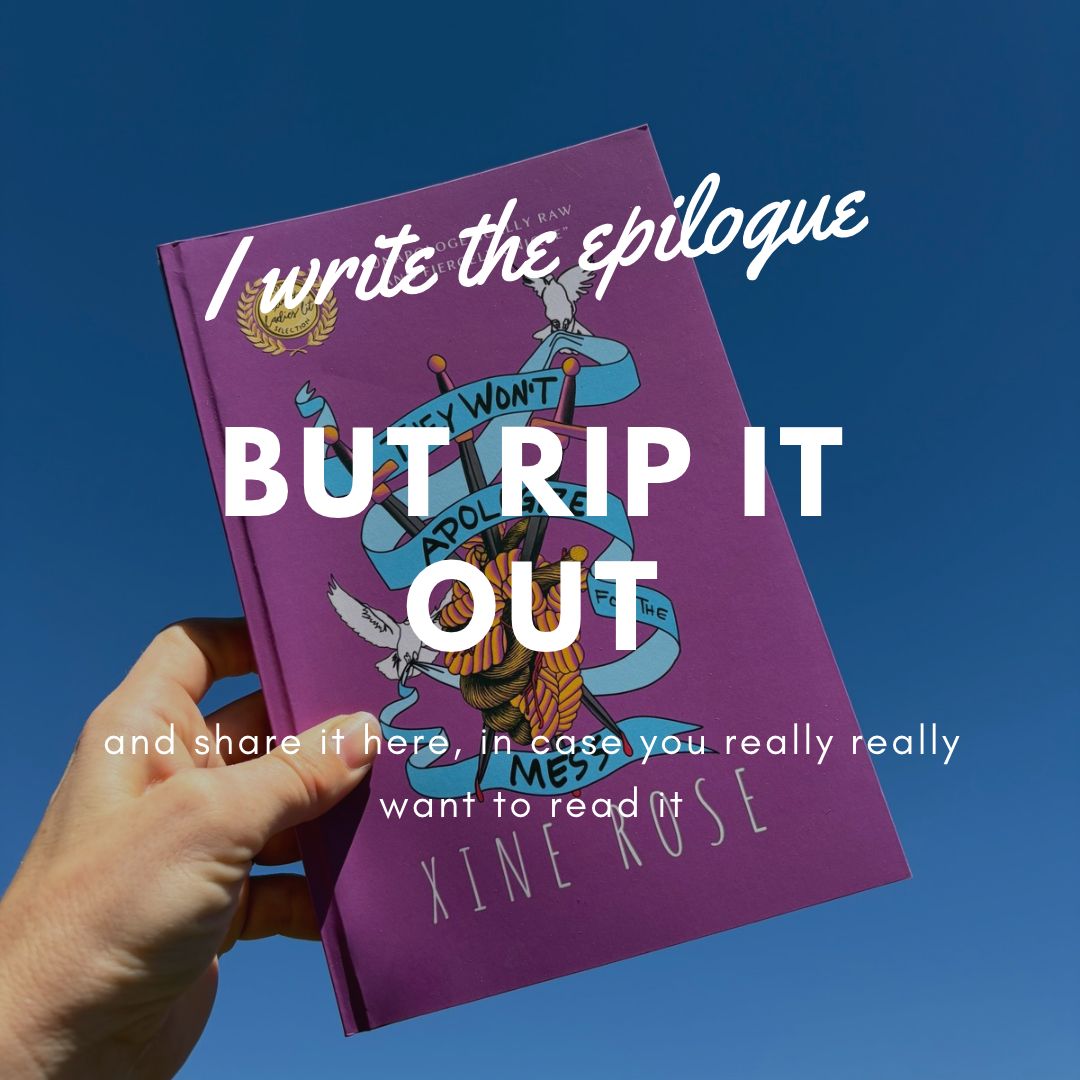
If you’re here, then you probably already know about the end of They Won’t Apologize for the Mess. If none of this rings a bell, then maybe don’t continue reading. Unless you love reading the end of the book first. Then by all means, proceed.
Rusty brown leaves have fallen to the ground, their branches left naked. The light that falls on Hunter in our bedroom is a cool blue. His hair is slicked back, darkened, like in the movies. With his black tux, he could have a woman in an elegant dress with stiletto heels next to him.
Instead he has me, in a blue fabric contraption that resembles a suit most of all. A lace collared shirt reveals my skin in a manner something between sex and old fashioned. My hair has grown, nearly touching my shoulders.
“I look like Tom Petty,” I say, standing next to him in the mirrored closet door.
Hunter bursts into song as he follows me to the kitchen
“…something I saw
In your eyes told me right away
That you were gonna have to be mine
When the strangest feeling came over me
Down inside, I knew right away…”
His piss poor impression of Petty makes me laugh. It is with a stupid smile that I take a lighter to our wax cake topper—a stock cast of a man and a woman, one in black and one in white, a modern day Adam and Eve cast from paradise and making the best of it. The wick ignites, crackling until it steadies.
Hunter shakes a jar of cornstarch, “Ready to rock and roll, fish sticks?”
Nodding, I pick up the cake. I carry it reverently as I follow Hunter to the back porch, where our families are waiting, standing around a cooling barbeque grill, unaware of our planned stunt. Greg wears an apron that says ‘Kiss the Cook.’ Susan arranges wildflowers in the vases by the leftover hamburger buns as my aunt talks her ears off. Simon is using a crooked branch to toss a paper plate up into the air because my uncle has already shown how he can spin ceramic plates on the end of a stick. Jodie and Paul are smoking cigarettes with some of Hunter’s cousins who brought their own beer, despite Susan’s darting eyes.
My mother is the first to look up at Hunter and I. She is pouring sun tea into mismatched glasses. A smile bursts across her face, as if she knew all along. She places two fingers between her lips and whistles loudly.
One by one, the small gathering realizes they have been invited to a surprise wedding.
Susan tears up.
Greg yells yeehaw, rips his apron off and swings it in circles like he is a rodeo clown.
Jodie, and Paul, and the cousins smile and smoke their cigarettes. Jodie blows me a kiss.
Simon doesn’t get what everyone is so excited about.
Hunter takes a handful of cornstarch and blows it through cake toppers flame. A fireball singes the autumn air but dissipates quickly. Cornstarch falls softly like the Summer becomes Winter, both all at once and also, slow and graceful.
Our guests gasp, those standing closer let the cornstarch land on the top of their head, their shoulders and their eyelashes. Simon’s eyes are wide and enchanted. I think to show him how he can blow cornstarch flames, later. He suddenly looks young to me.
The cake topper burns through its wick and the flame dies. The wax figures that remain are half of what they used to be, melted together, marblized. Not whole, so much as resurrected anew. Not indestructible but between one transformation and the next. I remove it carefully and lick the icing from the bottom.
Hunter takes a plastic knife and begins to cut the cake. He speaks to our family with his booming radio voice.
“Family and friends, thank you for coming today. If you can’t tell already, we may or may not have had ulterior motives. We aren’t going to apologize for surprising you, or breathing fire, or making a mess. Instead, we’re going to invite you to eat cake with us.”
The cake is simple and small. It will only feed those in attendance. None will be saved for some arbitrary future date. We have it now, then we will eat it, and then we will no longer have it. We’ll have to fill our bellies and satisfy our sweet tooths in some other way.
Hunter plates the cake slices and I hand them out to everyone. I am hugged, kissed, and congratulated. Simon doesn’t mention anything about my being anything more than the person who hands him the cake, which he wants very much. My mother takes a slice of cake, asks me if the ring ever showed up.
That’s what we say now, the ring. The ever elusive object that may or may not be buried in a sinkhole, or left in a Walmart parking lot, or digested with the best cake that I can imagine ever existed.
“Still no sign of the ring,” I say. “But we might go shopping for a new one. Cut our losses.”
“Are you sure you don’t want my old one? I think your dad would really like that you had it.”
I smile but shake my head, “No. Thank you, though.”
Susan welcomes me to the family. Greg hugs me aggressively, tells me, in case I haven’t heard, the Blue Devil has been repaired and returned to the Corvette Museum.
We agree that our wedding date and its return is a sign from the universe. All is right. He thinks this is a coincidence but I don’t tell him, I tracked the car’s repair everyday, made sure that I never forgot the return of the Blue Devil.
The last slice of cake is put on a plate. Hunter stabs it with a fork and motions to feed me. I let him. The icing melts in my mouth and a rush of pleasure stimulates my tongue. Hunter kisses me before he tries his own fork full of cake. Icing transfers from my lips to his and we laugh.
Then he lingers, like he might stay there as long as he wants—as long as we want. Like time is relative to our will, rushing by, standing still, weaving in and out of this moment so swollen with life that our taste buds sing, our fingertips vibrate, our bones sway to the undulation of the earth’s movements and death is a distant memory.
Feb 13th, 2014
There is a boy, about 12. He is too young to be in a Walmart by himself, but crazier things have happened in Bardstown, Kentucky. He is also too young to be in need of a savior, but such is life. Some of us are born where we belong. When we venture out, we always have a place to come back to. Home, they call it. Some of us are born homeless. Always seeking the place where we can rest and expand our lungs.
His name is Fitzgerald. A rich name from a rich family.
Fitzgerald shouldn’t be alone, but has run away from the man who is both his captor, villain, abuser, and father.
This isn’t the first time Fitzgerald has tried to run away. His father is a powerful man, with powerful resources. The death of his wife, during the birth of their only son was national news. He made sure of it. What would look better for a political campaign, than to be a single father, who’s very profitable casino helps fund and operate a soup kitchen downtown in Cincinnati, Ohio. What says ‘good man’ better than feeding the homeless?
And it’s so easy to make a 12 year old look like a ‘bad egg.’
“Boys will be boys,” the voters will say, as they read about the latest search for Fitzgerald. Some will be reminded of the daughters of presidents. Fitzgerald’s father wants the voters to think of presidents, when they think of him.
Today, Fitzgerald will truly and finally be free of his father. Once he leaves Walmart, he will decide where to hang himself. If he is lucky, the world will find his body before his father does.
In Walmart, Fitzgerald picks out blue rope. He doesn’t know why, it just grabs his attention. Even at the age of 12, he knows that if these are the last moments he has on earth, he should give himself every small pleasure he can. The blue rope makes him happy, reminds him of the sky.
For a young boy, with a powerful man looking for him, Fitzgerald takes his time going to the check out. He walks the aisles flapping his hands with nervous and excited energy. There is no one to tell him to stop. No one will tie his arms to his hips, or lock him in a room.
The other customers of Walmart notice the boy. They wonder if he’s dancing, or if he’s having a fit, but mostly they notice his smile and keep their thoughts to themselves—the thoughts that say, that boy ain’t right, as if there is something wrong with being unashamedly oneself, possibly even happy for once.
Happy isn’t the word Fitzgerald would use. He’s going to kill himself, for christsake. Resolved is the word.
Fitzgerald heads to the checkout lanes by way of the baking goods aisle. There is an older man, with salt and peppered auburn hair. The man holds a box of cornstarch close so he can read it. When the man sees Fitzgerald coming, he stops him.
“Boy, can you read the size of this for me?”
Fitzgerald debates walking right on past the man. What is one rude gesture on the way out? But Fitzgerald has never lost his good graces. A soft and full heart still beats in his chest. Plus, it’s not everyday that an adult sees Fitzgerald and thinks he can be helpful.
“What?” Fitzgerald asks.
“The size of this box.” The man points to the quantity and weight at the bottom, “There.”
Fitzgerald leans in, reads, “16 ounces or 1 pound.”
The man shakes his head as if this number displeases him.
Fitzgerald waits for a moment, curious if he can be helpful in another way. When the man grabs a second box. Fitzgerald decides he is no longer needed.
“Wait, son,” the man doesn’t have to reach for Fitzgerald’s elbow, or yell. The man speaks calm and softly to him. “I need you to do me a favor.”
Fitzgerald shakes his hands vigorously, as he says, “Okay.”
“I need you to buy this box of cornstarch here. And pray for me, that 16 ounces is enough.” The man places the box in Fitzgerald’s hand and pats him on the shoulder.
Fitzgerald wants to ask why. He wants to know what the next instructions are, after he buys the cornstarch. What then?
The man looks Fitzgerald in the eye and suddenly, the boy doesn’t need to know. The two part ways in the baking goods aisle. Fitzgerald proceeds forward to buy his rope and cornstarch. The items are bagged together, swinging from his fingers as he walks through the parking lot.
He wants to find a bridge. Remembers an overpass at the Bardstown exit. Briefly grieves the knowledge that a young boy walking across a bridge, fiddling with rope, can likely go unnoticed in Kentucky.
Just when Fitzgerald orients himself and turns towards the sound of the interstate, a man yells at him, “Excuse me.” The man is younger. Clean cut and perhaps a little over dressed for a Walmart. He is smiling nervously at Fitzgerald, unsure if this young boy can help or not.
“Can you help me push start my car real quick?”
Fitzgerald does know how to push start a car. Push starting a car is the easiest way to sneak a car out of a driveway undetected. Fitzgerald has been driving without a valid license for years with his friend George. When he thinks of George, the first signs of remorse creeps in. Fitzgerald would miss George.
The man in the Walmart parking lot is looking desperately at Fitzgerald. Like perhaps his day is verging on ruin. Fitzgerald nods his head yes. The hood of the car slams shut and a person emerges. They have a feminine face but short hair like a boy. Fitzgerald hands them his bag, with his rope and cornstarch.
If I can also ask you, dear reader, for one favor: please review They Won’t Apologize for the Mess. A review on the platform or your choice is the fuel every author needs to keep writing.
Leave a Reply